
Technical Guide to Protective Footwear Materials: The Role of EVA in Professional Safety
Protective footwear is a critical component of Personal Protective Equipment (PPE) across medical, industrial, and laboratory environments. The selection of material determines not only the comfort of the wearer but also the efficacy of the barrier against hazardous substances. While traditional safety boots focus on impact protection, modern professional footwear prioritizes lightweight ergonomics and chemical stability.
Ethylene-vinyl acetate, commonly known as EVA shoes material, has emerged as a primary choice for high-performance professional clogs and safety footwear. This guide analyzes the technical properties of EVA and compares it with alternative polymers used in the manufacturing of protective gear.
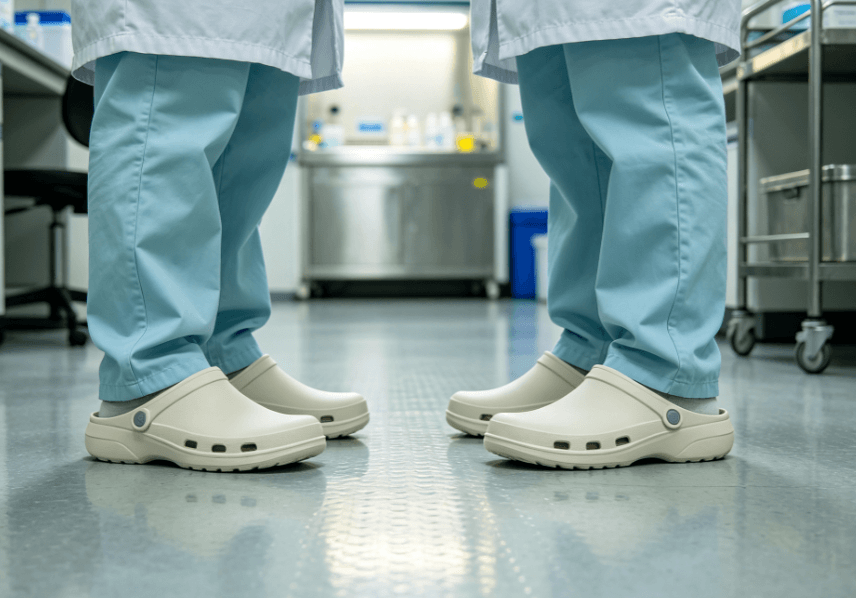
Understanding EVA Shoes Material: A Molecular Perspective
EVA is a copolymer of ethylene and vinyl acetate. In the footwear industry, it is categorized as a “closed-cell” foam. This structure is fundamental to its performance in sensitive environments. Unlike open-cell foams, the closed-cell nature of EVA prevents the absorption of liquids, including water, blood, and chemical reagents.
From a manufacturing standpoint, the ratio of vinyl acetate to ethylene determines the material’s flexibility and toughness. Higher vinyl acetate content increases the “rubbery” elasticity and clarity, while lower concentrations yield a stiffer, more durable plastic-like finish. For protective footwear, a balanced formulation ensures the shoe remains lightweight while maintaining structural integrity under repetitive mechanical stress.
Comparative Analysis: EVA vs. Traditional Footwear Materials
When evaluating protective footwear for procurement or project design, it is essential to compare EVA against Polyurethane (PU), Polyvinyl Chloride (PVC), and Rubber.
| Feature | EVA Shoes Material | Polyurethane (PU) | Rubber (Nitrite/Natural) |
| Weight | Ultralight (Approx. 0.95 g/cm³) | Medium | Heavy |
| Cushioning | Excellent (Energy return) | High | Low to Medium |
| Durability | Moderate to High | High | Very High |
| Chemical Resistance | High (Acids/Alkalis) | Moderate | High (Oils/Fats) |
| Cleanability | Autoclavable/Washable | Limited | Washable |
| Structure | Closed-cell foam | Solid or Micro-cellular | Solid |
Polyurethane (PU)
PU is often used for outsoles due to its high abrasion resistance. However, in medical or cleanroom environments, PU can be significantly heavier than EVA. While PU offers superior longevity in high-friction industrial settings, it lacks the inherent buoyancy and extreme lightweight properties required for personnel standing for 12+ hour shifts.
Rubber
Rubber remains the gold standard for slip resistance in oily environments. However, its high density leads to leg fatigue. In a medical context, such as those addressed by Unimed Medical’s specialized accessory standards, the weight-to-protection ratio often favors EVA for non-industrial hospital settings.
Technical Advantages of EVA in Protective Environments
1. Superior Shock Absorption
EVA acts as a natural shock absorber. In professional environments where workers are on their feet continuously, the material dissipates kinetic energy during the gait cycle. This reduces the strain on the musculoskeletal system, specifically the lower back and knees. Technical specifications for high-quality EVA footwear often target a Shore A hardness of 45–55 to balance support with comfort.
2. Chemical and Antimicrobial Resistance
The inert nature of EVA makes it highly resistant to many chemicals found in laboratories and surgical theaters. Because it is non-porous, it does not provide a substrate for bacterial growth. Many professional-grade EVA shoes are treated with antimicrobial additives during the injection molding process, ensuring the protection is embedded within the material rather than just a surface coating.
3. Decontamination and Maintenance
One of the most critical requirements for protective footwear in the medical sector is the ability to be sanitized. High-grade EVA shoes material can often withstand machine washing at temperatures up to 40°C or 50°C. Some specialized formulations are even compatible with chemical sterilization protocols, ensuring compliance with strict hygiene standards in sterile processing departments.

Manufacturing Considerations: Injection Molding vs. Compression
The performance of EVA shoes material is heavily influenced by the production method.
- Injection Molding: This process allows for complex, one-piece designs without seams. Seams are often the primary point of failure in protective footwear and a potential site for contaminant buildup. Injection-molded EVA clogs provide a uniform barrier.
- Compression Molding: Typically used for midsoles in athletic shoes, this provides higher density but may require adhesives to bond with other materials, which can degrade over time when exposed to harsh cleaning agents.
For professional PPE, the one-piece injection molded design is preferred for its “monocoque” structural strength and ease of disinfection.
Application-Specific Suitability
Choosing the right material depends on the specific hazards of the workplace:
- Medical & Clinical Settings: EVA is the preferred choice. The priority is hygiene, lightweight comfort, and slip resistance on wet (but not oily) floors. The compatibility with medical-grade disinfectants is a primary decision driver.
- Industrial Laboratories: EVA provides a barrier against accidental spills. However, if the environment involves heavy machinery or falling objects, EVA must be reinforced with composite or steel toe caps, often integrated into a more complex hybrid shoe structure.
- Food Processing: In these environments, resistance to animal fats is key. While EVA performs well, hybrid soles (EVA body with a Rubber outsole) are often utilized to provide the best of both worlds: lightweight body and superior fat-resistant grip.
Standards and Compliance
Professional protective footwear must adhere to international standards to be classified as PPE. When evaluating EVA footwear, technical managers should look for:
- EN ISO 20347: The standard for occupational footwear that does not require toe-protection against impact.
- EN ISO 20345: The standard for safety footwear (if the EVA shoe includes a protective toe cap).
- SRC Slip Resistance: This indicates the footwear has been tested on ceramic tile floors wetted with dilute soap solution and on smooth steel floors with glycerol.
Conclusion
Material science is the foundation of effective PPE. EVA shoes material has redefined the expectations for professional footwear by proving that “protective” does not have to mean “heavy.” By leveraging a closed-cell, lightweight, and chemically resistant structure, EVA provides a technical solution for modern professionals in demanding environments. When selecting footwear, engineers and procurement specialists must weigh the specific chemical exposures and ergonomic needs of their staff against the unique properties of these advanced polymers.

FAQ:
What makes EVA shoes material different from regular foam?
Regular foam is often open-cell, meaning it can absorb liquids and bacteria. EVA shoes material is a closed-cell foam, which makes it waterproof, non-absorbent, and much more durable for professional use.
Can EVA protective shoes be sterilized?
Most high-quality EVA footwear can be machine washed or chemically disinfected. However, not all EVA is autoclavable (high-pressure steam). You must check the manufacturer’s specific temperature rating, as standard EVA may deform at temperatures above 60°C.
Is EVA slip-resistant?
EVA itself has a decent coefficient of friction on dry surfaces. However, for professional safety standards (like SRC), manufacturers often design specific tread patterns or integrate rubber inserts into the sole to enhance grip on wet or soapy floors.
How long does EVA footwear last in a professional setting?
In a typical medical or laboratory environment, a high-quality pair of EVA shoes usually lasts 6 to 12 months. The material eventually “compresses” over time, losing some of its shock-absorption properties, at which point it should be replaced to maintain ergonomic benefits.
Is EVA footwear environmentally friendly?
EVA is generally considered more eco-friendly than PVC because it does not contain chlorine and requires fewer plasticizers. Additionally, many manufacturers are now moving toward “Bio-EVA” or recyclable formulations to reduce the environmental footprint of PPE.
Reference Sources:
- ISO (International Organization for Standardization): ISO 20344:2021 – Personal protective equipment — Test methods for footwear
- ASTM International: ASTM F2413-18 – Standard Specification for Performance Requirements for Protective (Safety) Toe Cap Footwear
- ScienceDirect: Analysis of Ethylene Vinyl Acetate (EVA) properties in shoe manufacturing
- Health and Safety Executive (HSE): Assessing the slip resistance of footwear