How Global Buyers Source Products from China
Sourcing products from China means buying manufactured goods from Chinese suppliers — factories, trading companies, or sourcing agents — and importing them into your market. The country’s industrial clusters, export infrastructure, and unit costs combine into a sourcing base few regions can match. Handled well, it lowers landed cost; handled carelessly, it creates quality, compliance, and delivery risk.
This guide explains the process buyers actually use: how orders move from specification to shipment, what drives total cost, and how supplier channels differ. It then covers the checks that protect regulated goods such as medical supplies. You will leave with a working evaluation framework, not generic advice.
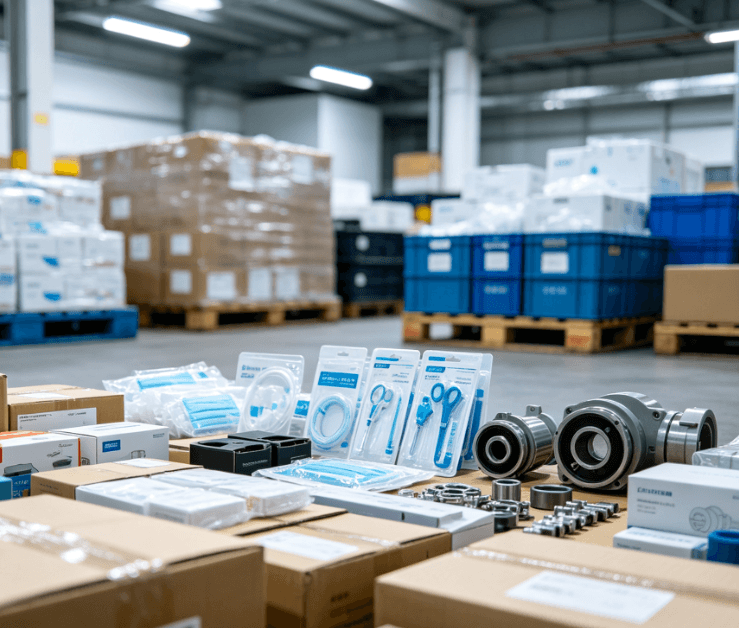
How the China Sourcing Process Works: 8 Steps That Matter
Most sourcing projects follow the same sequence, though product class and order size change the emphasis. Skipping verification to save time is the most expensive shortcut in this business.
- Write the specification. Product drawings, material grades, dimensions, packaging, and target standards come first.
- Build a shortlist. Match suppliers against product category and export experience — price alone disqualifies nobody and selects nobody.
- Verify credentials. Check the business license, export scope, and registration files.
- Qualify the factory. Video audits fit low-risk goods; regulated products need on-site review.
- Negotiate terms. Settle price, tooling, payment schedule, and Incoterms before production starts.
- Inspect production. Run pre-production checks and in-line inspection at agreed AQL levels.
- Manage shipment. Confirm loading, documentation, and customs clearance, then close the loop.
Buyers who skip steps two through five usually pay back the saved weeks in rework.
What Actually Drives the Total Cost of Sourcing from China
The ex-works price is only the visible part of cost. Landed cost includes tooling, inspection, freight, duties, and rework when quality slips. In large-volume production, a small defect rate can quietly erase the whole price advantage.
- Product complexity — tooling amortization, secondary operations, and tolerances
- Volume and order structure — how minimum quantities shape unit price
- Compliance work — testing, registration, documentation, and certification renewals
- Freight and Incoterms — who owns the risk at each transfer point
- Payment terms — deposit structures and currency exposure
China’s price edge is real but not automatic. Labor and material costs have risen, so the durable advantage now sits in supply-chain density — components, tooling, and finishing services within one or two provinces. Buyers who price only the factory quote often discover the gap later, at the invoice for freight and duties.
Factory, Trading Company, or Sourcing Agent: Which Channel Fits?
Channel choice shapes price, flexibility, and risk. The right answer depends on order size, product range, and how much oversight you can commit.
| Channel | Best suited for | Typical drawback | How they work |
| Factory direct | High-volume, technical products | Higher MOQs, slower communication | You buy from the production line owner |
| Trading company | Mixed baskets, smaller volumes | Price markups, opaque factory chain | They consolidate several factories |
| Sourcing agent | First-time importers, compliance-heavy goods | Fees on top of factory price | They represent you on the ground |
Factories earn their place through price and control when volumes justify direct relationships. Trading companies simplify consolidated baskets that would take weeks to assemble alone. Agents add cost but replace your absence — a reasonable bridge for early shipments, not a permanent structure.
Sourcing Medical Supplies from China: Compliance and Quality Specifics
Medical goods carry the heaviest compliance burden in importing. Market access depends on regulatory files, not product quality alone. The sourcing process must therefore add documentation and verification steps that hardware projects never need.
- Map your market’s rules first. The US requires FDA establishment registration and device listing; Europe applies the Medical Device Regulation (EU) 2017/745 and CE marking.
- Demand a real quality system. ISO 13485 certification aligned to the product family, verified at audit.
- Confirm sterilization claims. Gamma, ethylene oxide, or steam each suit different materials; match the method to the product.
- Inspect against AQL. ISO 2859-1 sampling plans set lot acceptance thresholds for visual and functional defects.
- Audit the whole chain. Material suppliers and subcontracted sterilization belong in scope.
Category breadth changes the strategy. A full-line medical exporter, such as Unimed Medical Instrument Company in Zhangshu, Jiangxi, lets importers consolidate audits and orders into one compliance relationship. The firm supplies surgical consumables, dressings, home-care devices, and laboratory products to buyers across Africa. One-stop sourcing shrinks the compliance surface you must monitor.
Private label raises the bar further. When your brand appears on the device, regulators treat you as the responsible party, so supplier files become your legal evidence. Request batch test reports and device documentation up front, not after customs clearance.
How to Vet a China Supplier Before Your First Order
Vetting is document review plus verification. Legitimate exporters can produce the paper trail within days, so slow responses are themselves a signal.
- Business license whose scope matches the product category and export activity
- Quality certificates — ISO 13485 or ISO 9001, plus product files such as CE documentation or FDA listing
- Export evidence — customs records, bills of lading, or bank settlement history
- Named references — buyers you can contact directly
- Site proof — current photos, a live video tour, or a third-party audit report
Treat vague pricing, stock photos, and pressure for full advance payment as red flags. Standard export terms run a deposit with the balance against shipping documents — typically 30/70 under T/T or the equivalent under a letter of credit. Any deviation from that pattern deserves a written explanation.
China sourcing rewards preparation more than negotiation. Define the spec, verify the supplier, and build compliance into the workflow from the first inquiry. Buyers who keep that sequence intact turn China’s manufacturing density into a durable cost advantage — and skip the expensive lessons.
FAQ
Is it cheaper to buy directly from Chinese factories than through trading companies? Usually, when volume justifies it. Direct factory sourcing removes the intermediary markup but raises minimum order quantities and communication load. Trading companies stay competitive for consolidated baskets, where their markup is smaller than the cost of managing ten factories.
How long does a typical order take from first inquiry to delivery? Plan for eight to fourteen weeks on standard products. Sampling and qualification take two to four weeks, production four to six, and ocean freight two to four depending on the route. Regulated goods with testing or registration add weeks, so factor that in before committing to a launch date.
What documents should I request from a supplier before ordering? Ask for the business license, quality certificates, export records, and batch test reports. For medical products, add the device registration or listing file for your target market. Written answers are useful; verifiable documents are what protect you.
Do I need to visit the factory in person? Not always, but do not skip verification. For low-risk goods, a recorded video audit plus third-party inspection may be enough. For medical devices or high-value custom products, an on-site visit before mass production is the industry norm — the cost of the trip is small against a failed shipment.
Reference Sources
- ISO 13485:2016, Medical devices — Quality management systems — Requirements for regulatory purposes.
- ISO 2859-1:2026, Sampling procedures for inspection by attributes — Part 1: Sampling schemes indexed by acceptance quality limit (AQL).
- U.S. FDA, Device Registration and Listing.
- European Commission, Medical Devices Sector (Regulation (EU) 2017/745).
- International Chamber of Commerce, Incoterms® 2020 Rules.
- UN Comtrade, China export statistics.