
Disposable medical supplies are best sourced as department-ready groups, not as one undifferentiated “consumables” list. For hospital buyers, the practical groups are ward care, procedure-room setup, diagnostics, and infection-prevention and waste logistics. Each group needs a defined user, approved setting, pack format, documentation set, replenishment point, and disposal route.
That approach makes the purchasing conversation clearer without turning a buying guide into clinical advice. Standard Precautions are used for all patient care and depend on risk assessment; PPE is only one element within that broader framework.[1] Local policy, applicable regulations, product labelling, and the manufacturer’s instructions for use should always decide what a facility approves and how it is handled.
Map supplies to the department that owns the workflow
A department-oriented taxonomy helps procurement separate fast-moving basics from items that need a more specific review. The examples below are buying categories, not instructions for patient care or a statement that every hospital should use the same list. CDC guidance also makes clear that additional precautions can sit alongside Standard Precautions, so demand and approved items can change by facility and situation.[2]
| Workflow area | Commonly mapped disposable supply groups | Procurement questions | Handover point |
|---|---|---|---|
| Wards | Examination gloves, masks or gowns where policy requires them, gauze and dressing items, patient-care pads | What sizes, materials, pack sizes, and ward stock locations are approved? | Ward store or point-of-use cabinet |
| Procedure rooms | Procedure PPE, drapes, syringes and needles, fluid-management or suction accessories | What is the labelled intended use, required packaging status, and device compatibility? | Procedure set or room stock |
| Diagnostics | Specimen-collection items, swabs, containers, tubes, and single-use laboratory accessories | What collection workflow, label format, transport interface, and traceability are required? | Collection point or laboratory receiving |
| Infection-prevention and logistics | PPE replenishment lines, cleaning consumables, waste-segregation and sharps-related items | How will stock be separated, stored, issued, and routed into the facility waste plan? | Environmental services, waste hold, or central store |
Ward and general-care supplies
Ward demand is usually shaped by high-frequency use, many storage points, and a wide range of users. Grouping gauze, dressings, gloves, and patient-care disposables by use area can help purchasers compare case quantities, inner packs, labelling, and replenishment rules before focusing on unit price.
For a catalogue starting point, the Unimed Medical products catalogue visibly includes a Medical Consumable grouping.[7] Its Sterile Gauze Swab product page is a useful example of a product-page destination, but a buyer should request the current documentation and confirm the exact item rather than infer specifications from a web listing.[8]
Sterile gauze swabs in protective packaging.
Procedure-room supplies
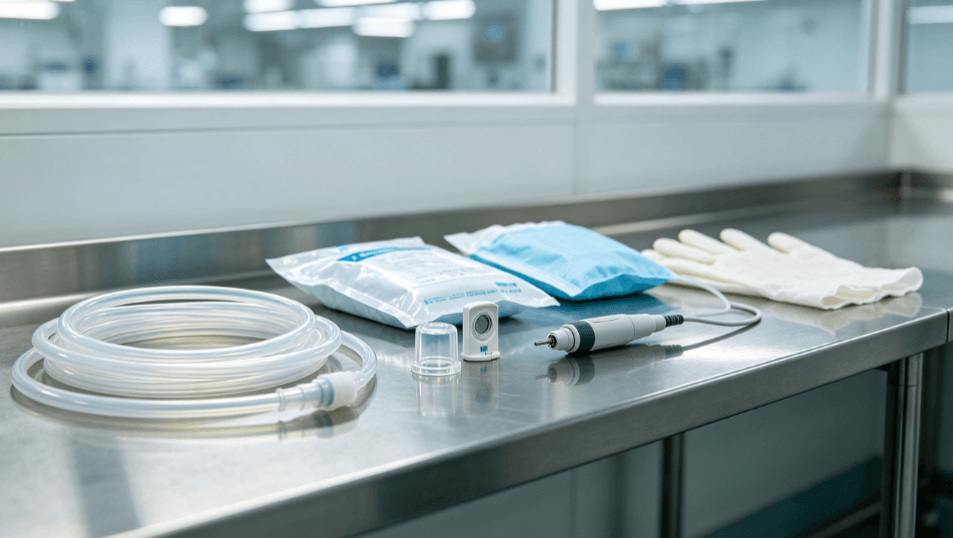
Procedure-room purchasing benefits from separating barrier items, administration items, and accessories that connect with a named device or set. This avoids mixing products that look similar in a catalogue but differ in intended use, packaging status, or compatibility requirements.
Keep reusable-device requirements separate from disposable purchasing. CDC recommends central processing for most cleaning, disinfection, and sterilization of patient-care devices in hospitals to help control quality.[3] In an RFQ, mark each line as disposable, reusable, or an accessory to a reusable device, then route the line to the responsible department for confirmation.
Diagnostics and infection-prevention logistics
Diagnostics teams often need a clear chain from collection point to laboratory receiving. A useful buying group can include specimen-collection consumables and single-use laboratory accessories, with the required label, package, and transport interface specified by the facility. This is a procurement map, not a specimen-handling protocol.
For logistics, give sharps-related items and general waste-related items their own review rather than hiding them in a generic disposables category. WHO lists needles, syringes with attached needles, infusion sets, scalpels, pipettes, and broken glass among examples of sharps waste.[5] The applicable waste classification and disposal route remain local decisions.
Build the specification before comparing quotations
A sound comparison starts with a specification that says what the hospital is actually buying. WHO advises decision makers to consider technical specifications before purchase or donation, because specifications support planning and resource management.[6] For disposable medical supplies, that principle can be translated into a concise, line-by-line sourcing checklist:
- Use context: Name the department, approved workflow, and whether the item is disposable, reusable, or paired with another device.
- Labelled status: Request the current label and instructions for use. Record intended use, any declared single-use status, and sterile or non-sterile status only as stated by the supplier.
- Physical configuration: Specify sizes, material preferences, connection or device interfaces, count per inner pack, and units per case. Do not assume that similarly named items are interchangeable.
- Quality and market documentation: State the destination market and ask for the documents required by the purchaser’s regulatory and quality system. Verify them through the appropriate route; do not treat a website statement as proof.
- Traceability and receiving: Define the identifiers, lot or batch information, expiry information where applicable, and document format the receiving team needs.
- Supply and storage data: Ask bidders to complete a current quote sheet covering order minimums, pack dimensions, storage conditions, commercial terms, and any information needed for demand planning. Validate responses during the tender process.
- Waste interface: Confirm that the packaging and item route fit the facility’s approved segregation, collection, storage, and disposal plan. WHO emphasizes segregation and an end-to-end approach to health-care waste management.[5]
The checklist is deliberately specific about evidence, not outcomes. For example, FDA describes medical gloves as disposable PPE and as one part of an infection-control strategy, rather than as a stand-alone solution.[4] Its regulatory discussion is U.S.-specific, so international buyers should use the requirements of the market where the products will be placed.
Turn the checklist into a cleaner RFQ
An RFQ for hospital disposable supplies should identify the workflow owner as well as the buyer. Add columns for department, product family, preferred configuration, estimated consumption period, required documents, approval status, and delivery destination. Attach a separate question sheet for substitutions so a supplier cannot silently replace a requested configuration with a similar-looking alternative.
Then evaluate quotations on a like-for-like basis: the approved specification, total delivered package configuration, documentation completeness, traceability fit, and waste-logistics fit. WHO’s procurement guidance frames effective procurement as clear and accountable work that supports appropriate health technology purchasing.[9] That is a better basis for comparison than an unsupported claim about product performance.
For a restrained next step, send shortlisted suppliers an RFQ that includes the completed checklist and ask them to identify any gaps or exceptions. If reviewing the Unimed range, begin with its catalogue and request written confirmation of the exact product documentation, configuration, and commercial terms relevant to your market before making a sourcing decision.

FAQ
What are disposable medical supplies in a hospital?
They are procurement lines intended to be used and then handled through the facility’s approved disposal or waste-management workflow, as indicated by their labelling and local policy. The category can include patient-care items, PPE, diagnostic consumables, and logistics-related items.
Which hospital departments use disposable medical supplies?
Wards, procedure rooms, diagnostics or laboratories, central stores, environmental services, and infection-prevention teams may all have a role. The exact allocation depends on the hospital’s services, approved products, and local operating model.
How should a hospital classify disposable supplies for procurement?
Start with the owning workflow area, then add intended use, labelled status, configuration, documentation needs, storage point, and waste route. This produces a more reviewable list than grouping every item under “consumables.”
What documents should buyers request from a supplier?
Request the label, instructions for use, current product configuration, and the regulatory or quality documents required by the destination market and the purchaser’s system. Review them through the organization’s established qualification and approval process.
Are disposable supplies the same as PPE?
No. PPE is one supply group that may be disposable, while hospital disposable medical supplies can also include ward, procedure, diagnostic, and logistics items. PPE selection must still follow the facility’s risk assessment and policy.[1]
References
[1] CDC, Standard Precautions for All Patient Care
[2] CDC, Transmission-Based Precautions
[3] CDC, Summary of Recommendations for Disinfection and Sterilization in Healthcare Facilities
[4] FDA, Medical Gloves
[5] World Health Organization, Health-care waste
[6] World Health Organization, Procurement and technical specifications
[7] Unimed Medical, Products catalogue
[8] Unimed Medical, Sterile Gauze Swab
[9] World Health Organization, Procurement process resource guide