
Understanding the Architecture of Plastic Disposable Products Manufacturing
In the modern industrial landscape, particularly within the healthcare and laboratory sectors, “disposable” does not mean “simple.” Rather, the manufacturing of plastic disposable products involves complex polymer science, high-precision engineering, and stringent regulatory compliance. Indeed, whether it is a single-use sensor housing, a respiratory mask component, or a diagnostic cartridge, the path from raw resin to finished product requires a controlled environment and specific technical workflows. To address these complexities, this guide examines the core manufacturing principles, material selections, and quality protocols that define the production of high-standard plastic disposables.

Material Selection: The Foundation of Performance
The performance of any plastic disposable product begins with polymer selection. Manufacturers must balance mechanical properties with chemical resistance and biocompatibility.
In the medical and technical fields, common resins include:
- Polyvinyl Chloride (PVC): Widely used for flexible tubing and blood bags due to its versatility and cost-effectiveness.
- Polycarbonate (PC): Chosen for components requiring high impact resistance and optical clarity, such as stopcocks or luer locks.
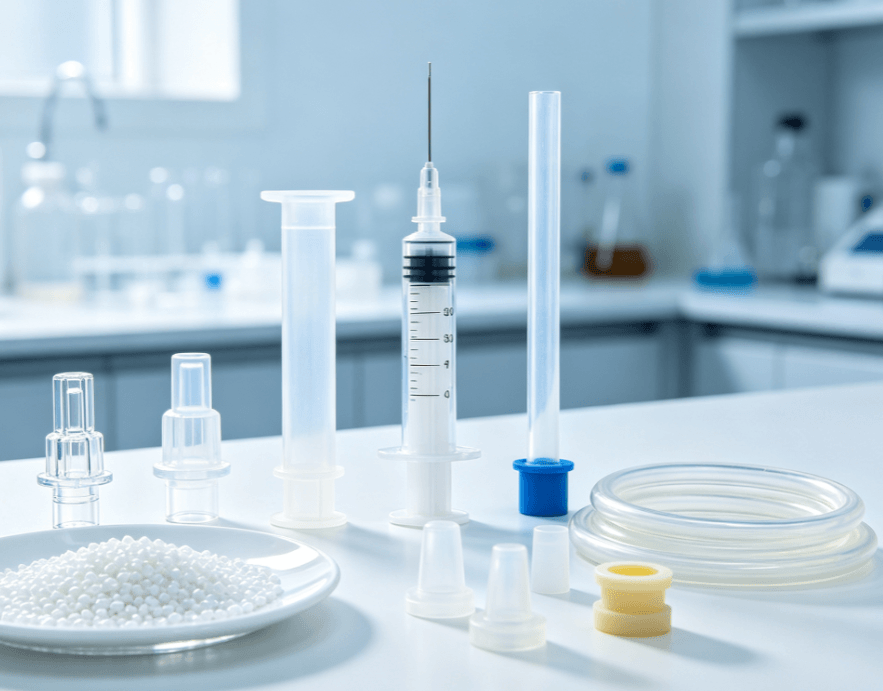
- Polypropylene (PP): Frequently used for labware and syringes because of its excellent chemical resistance and ability to withstand autoclaving.
- Thermoplastic Elastomers (TPE/TPU): Essential for overmolding applications where a soft-touch grip or flexible seal is required.
Comparison of Common Manufacturing Polymers
| Material | Key Property | Common Application |
| PC | High Clarity/Strength | Dialyzers, Connectors |
| PP | Chemical Inertness | Test Tubes, Syringe Barrels |
| PE | Low Friction | Catheter Components |
| TPU | Elasticity/Durability | Soft-touch Housings, Tubing |
Primary Manufacturing Processes
The method used to produce plastic disposable products depends largely on the geometry of the part and the required production volume.
1. Precision Injection Molding
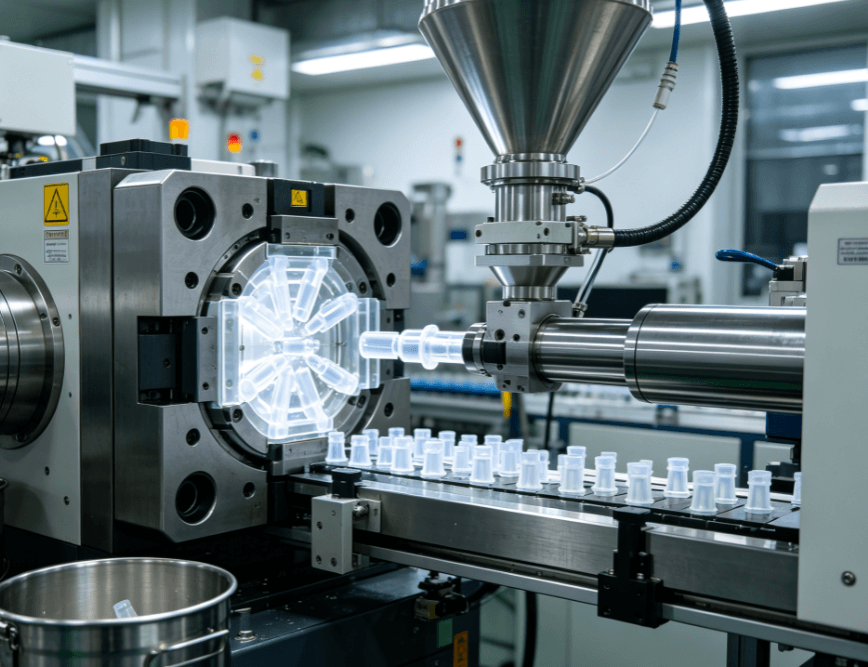
Injection molding is the most common process for high-volume disposables. It involves melting plastic granules and injecting the molten resin into a high-precision steel mold.
- Cycle Efficiency: This process allows for extremely fast production cycles, often producing dozens of parts in seconds.
- Complexity: It supports intricate features, such as internal threads, thin-walled sections, and integrated snap-fits.
- Tolerance Control: Modern electric molding machines can maintain tolerances within microns, which is critical for parts that must interface with electronic sensors or medical monitors.
2. Plastic Extrusion
For products like medical tubing, catheters, or multi-lumen leads, extrusion is the primary method. Molten plastic is forced through a die to create a continuous profile. This process is highly sensitive to temperature and pressure fluctuations, which can affect the internal diameter (ID) and outer diameter (OD) consistency.
3. Blow Molding and Thermoforming
Blow molding is utilized for hollow parts like bottles or containers. Thermoforming, on the other hand, involves heating a flat sheet of plastic and stretching it over a mold using vacuum pressure—a common method for protective trays and packaging lids.
The Role of Cleanroom Environments
In the production of high-end plastic disposables, the environment is as critical as the machinery. Most medical-grade disposables are manufactured in ISO-certified cleanrooms (typically Class 7 or Class 8).
Cleanroom manufacturing ensures:
- Particulate Control: Minimizing airborne dust that could compromise the integrity of the plastic or contaminate a sterile field.
- Bioburden Management: Controlling the level of microbial life on the product surface before it undergoes final sterilization.
- Controlled Parameters: Maintaining specific temperature and humidity levels to ensure consistent polymer behavior during the molding process.
Engineering for Biocompatibility and Compliance
Manufacturing plastic disposable products for technical sectors requires adherence to international standards. For products used in patient care or laboratory diagnostics, the materials must meet ISO 10993 standards for biocompatibility.
Engineers must ensure that:
- Leachables and Extractables: The plastic does not release harmful chemicals when in contact with fluids or skin.
- Sterilization Compatibility: The design and material can withstand common sterilization methods such as Ethylene Oxide (EtO), Gamma radiation, or E-beam without losing structural integrity or discoloring.
Integrating Precision Components
As seen in specialized sectors like medical monitoring—exemplified by the diverse range of patient monitoring accessories and disposable sensors—the plastic housing is often just one part of a larger system. Manufacturing these products requires “Insert Molding” or “Overmolding,” where plastic is molded directly around metal pins, wires, or electronic sensors. This creates a seamless, durable, and often waterproof bond that is essential for reusable/disposable hybrid systems.
Quality Inspection and Testing Protocols
To maintain high yields and safety, manufacturing facilities employ rigorous testing phases:
- Dimensional Inspection: Using Automated Optical Inspection (AOI) or CMM (Coordinate Measuring Machines) to verify part geometry.
- Leak Testing: Critical for fluid-delivery disposables or air-path components.
- Tensile Strength Testing: Ensuring connectors and joints do not fail under mechanical stress.
- Visual Inspection: Checking for common molding defects such as flash, sink marks, or short shots.
FAQ
What are the most common plastics used in disposable medical products?
The most common materials include Polypropylene (PP), Polyethylene (PE), and Polyvinyl Chloride (PVC). For high-performance parts requiring transparency and toughness, Polycarbonate (PC) is frequently utilized.
Why is cleanroom manufacturing necessary for plastic disposables?
Cleanrooms prevent environmental contaminants from being embedded in the plastic during the melting and cooling phases. This is vital for maintaining the safety and sterility of products used in healthcare and laboratory settings.
How does sterilization affect plastic disposable design?
Designers must choose materials that won’t become brittle or yellow when exposed to Gamma radiation or high-temperature steam. For example, some grades of Polypropylene are specifically formulated to be “Gamma stable.”
What is the difference between injection molding and extrusion in disposable production?
Injection molding is used for discrete, complex shapes (like a connector or a housing), while extrusion is used for continuous, long shapes (like tubing or wire insulation).
Reference Sources
- ISO 13485:2016: Medical devices — Quality management systems — Requirements for regulatory purposes. iso.org
- ASTM D638: Standard Test Method for Tensile Properties of Plastics. astm.org
- FDA – CFR Title 21: Quality System Regulation for Medical Device Manufacturers. fda.gov
- ISO 14644: Cleanrooms and associated controlled environments. iso.org