
What Is a Mechanical Blood Pressure Monitor?
A mechanical blood pressure monitor is a non-automated blood pressure measuring device in which cuff pressure is generated and released by hand, and the reading is taken by an operator who observes both a pressure gauge and the sounds of blood flow. The clinical term for the device is a sphygmomanometer; when the gauge is a mechanical dial rather than a mercury column, it is specifically an aneroid sphygmomanometer.
The word “mechanical” describes the sensing element, not the whole procedure. Inside an aneroid gauge, a stack of sealed elastic chambers (typically a bellows or capsule) expands and contracts with cuff pressure, and a geared linkage converts that movement into needle deflection across a graduated dial. Nothing in the pressure path is electronic, which is why these devices keep working in places where batteries and mains power do not.
A complete mechanical set typically contains five parts:
| Component | Function | Typical variation |
|---|---|---|
| Cuff (sleeve) | Wraps the limb and transmits pressure to the artery | Nylon or cotton; adult, large adult, child, infant sizes |
| Bladder | Inflatable bag inside the cuff that actually compresses the artery | Single-tube or two-tube; replaceable |
| Inflation bulb and valve | Manual pump plus a screw or trigger valve that controls the deflation rate | Standard bulb, palm bulb, or integrated trigger valve |
| Aneroid manometer | Dial gauge that converts cuff pressure into a needle reading in mmHg | Shock-protected, 50–60 mm dial, or larger desk/wall dial |
| Stethoscope (or phonendoscope) | Detects Korotkoff sounds so the operator can identify systolic and diastolic points | Separate, or built into the cuff head |
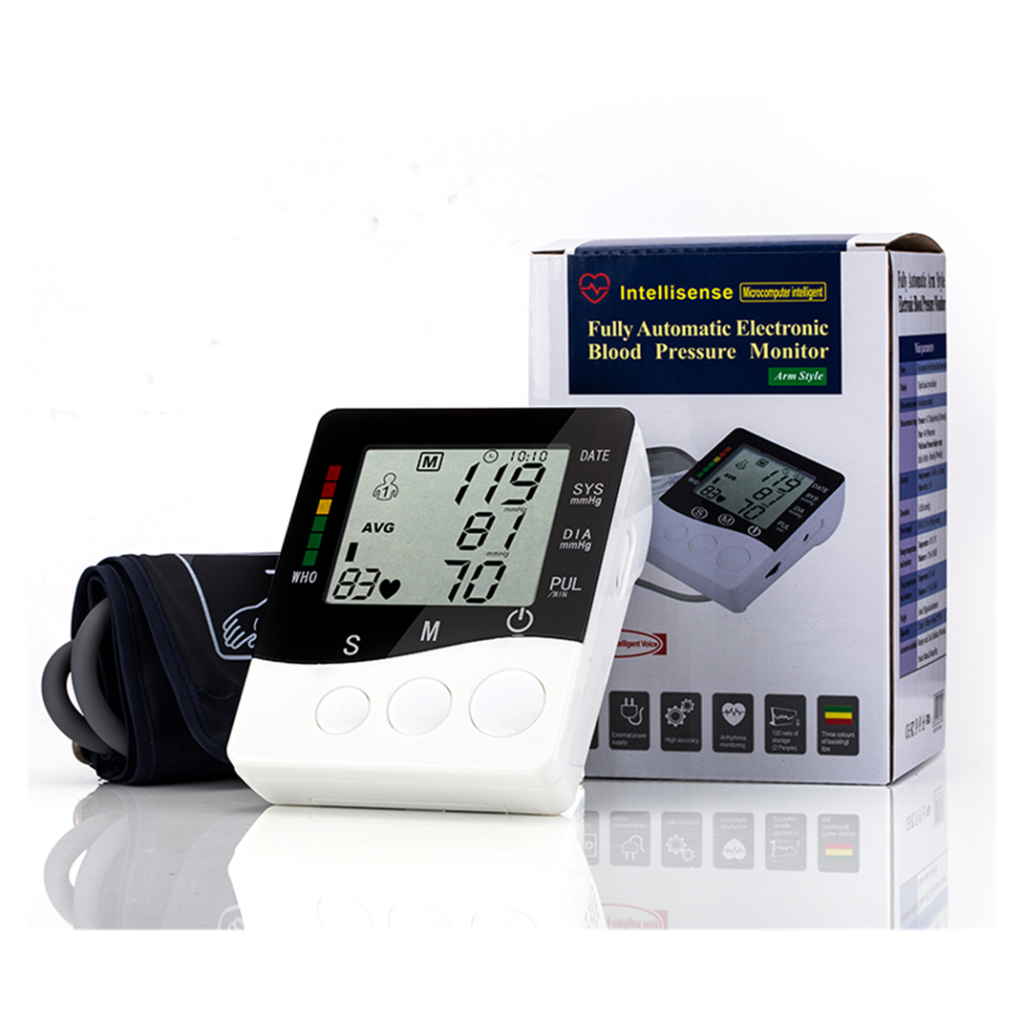
This component set is what distinguishes a mechanical monitor from an electronic blood pressure monitor, which replaces the bulb, the operator’s ear and the dial with a pump, a pressure sensor and a microprocessor. The two are not interchangeable products, and they are not covered by the same standard.
How a Mechanical Blood Pressure Monitor Works
Mechanical monitors operate on the auscultatory principle. Blood pressure is inferred from when arterial sounds appear and disappear as the cuff pressure falls, and the operator is the sensor that detects those transitions.
- Position the cuff. The cuff goes on bare skin, with its centre over the brachial artery on the upper arm and its lower edge roughly 2–3 cm above the elbow crease. The bladder should encircle about 75–100% of the arm circumference.
- Inflate above systolic pressure. The bulb raises cuff pressure until the artery is fully occluded — normally 20–30 mmHg above the point where the pulse sound disappears.
- Deflate at a controlled rate. The valve is opened so pressure falls at roughly 2–3 mmHg per second. Rushing this step is one of the most common causes of an inaccurate mechanical reading.
- Listen for the first Korotkoff sound. The first clear tapping sound marks systolic pressure. Read it off the dial at that moment.
- Listen for the last Korotkoff sound. When the sounds fade and vanish, that pressure is diastolic.
- Fully deflate and record. The valve is opened completely, the cuff removed, and both values logged with the date, time and arm used.
Three things about this sequence matter for anyone evaluating the device category. First, the manometer measures cuff pressure, not intra-arterial pressure — the blood pressure value is an inference drawn from sound transitions. Second, the deflation rate and the operator’s hearing are both part of the measurement chain, which is why operator training is a genuine accuracy variable rather than a formality. Third, because a single operator cannot comfortably inflate the bulb, position the stethoscope head and read the dial at the same time, mechanical measurement assumes two people: one patient and one trained operator.
The standard measurement conditions apply to every device type. The patient should sit with back supported, feet flat on the floor and the arm resting at heart level; avoid caffeine, exercise and smoking for 30 minutes beforehand; and rest quietly for about five minutes before the first reading. Taking two readings a minute apart and averaging them is standard practice. Technique errors of this kind routinely shift a reading by 5–15 mmHg — more than the accuracy difference between a good mechanical monitor and a good digital one.
Types of Mechanical Blood Pressure Monitors
Mechanical sphygmomanometers are usually classified by how the gauge is mounted, because that determines where they can be used and how often they need calibrating.
| Format | Description | Best suited to |
|---|---|---|
| Handheld / mobile | Gauge and bulb in one hand unit, cuff in the other, supplied in a soft case | Ambulance and field teams, home visits, ward rounds, mobile clinics |
| Palm-style | Trigger-style valve and gauge built into a single grip, one-handed operation | High-frequency clinical use where speed and one-hand control matter |
| Desk / portable | Large round dial on a stand, longer tubing | Consulting rooms, fixed examination desks |
| Wall-mounted | Gauge fixed to a wall bracket with long tubing and a cuff on a hook | Examination rooms with high patient throughput |
| Trolley-mounted | Gauge and accessories on a mobile stand | Emergency departments, theatre recovery, ICU step-down |
| Wrist aneroid | Gauge strapped to the wrist, used mainly for arteriovenous fistula monitoring | Specialist dialysis and vascular access settings |
The last row is worth flagging, because it is the source of a common sourcing confusion. A mechanical wrist device is a niche instrument used by trained staff to check a fistula, and it is not the same product as a consumer wrist monitor. If you are buying for general blood pressure screening or home use, the wrist format you are looking for is almost certainly the electronic one described further down.
Mechanical vs Digital Blood Pressure Monitors: What Actually Differs
The comparison usually gets reduced to “mechanical is more accurate, digital is easier.” That framing is too simple. Both categories can be accurate, and the differences that decide a purchase are mostly about who operates the device, which standard it is tested against, and what it costs to keep it accurate over its service life.
| Factor | Mechanical / aneroid | Automated digital |
|---|---|---|
| Measurement principle | Auscultatory — operator detects Korotkoff sounds | Oscillometric — device detects and analyses pressure oscillations |
| Operator requirement | Trained operator plus a second person as patient | Single user, one-button operation |
| Reading displayed | Analogue needle on a dial | Systolic, diastolic and pulse on an LCD; often with a WHO classification strip |
| Power supply | None | Batteries or mains adapter |
| Main applicable standard | ISO 81060-1 | IEC 80601-2-30, with clinical validation to ISO 81060-2 |
| Accuracy verification | Static pressure calibration against a reference manometer | Static pressure check plus clinical validation study |
| Calibration burden | High and recurring — handheld units every 2–4 weeks in clinical use | Lower — periodic check against a calibrated reference device |
| Cost profile | Low purchase price, higher lifetime maintenance | Higher purchase price, lower operating overhead |
| Data handling | Manual logging only | On-board memory, averaging, sometimes app or Bluetooth transfer |
| Failures in the field | Cracked tubing, hardened bulb, lost calibration after impact | Dead batteries, sensor or pump failure, cuff wear |
Read across the table and the trade-off resolves into a single question: is there a trained operator present at every measurement? If yes, a mechanical monitor is efficient, cheap to own and independent of power. If no, the operator requirement becomes the deciding factor, and no amount of mechanical precision compensates for measurement that cannot be taken at all.
Accuracy, Standards and Calibration: What Buyers Should Verify
Two different standards govern the two device types, and buyers who ask for the wrong one tend to receive the wrong documentation.
| Standard | Applies to | What it covers |
|---|---|---|
| ISO 81060-1:2007 | Non-automated sphygmomanometers | Requirements, test methods, accuracy and labelling for operator-observed measurement |
| IEC 80601-2-30 | Automated non-invasive sphygmomanometers | Basic safety and essential performance of powered, automated devices |
| ISO 81060-2 | Automated measurement type | Clinical validation of accuracy against a reference method in human subjects |
| ISO 13485 | The manufacturing organisation | Quality management system for medical device production |
| ISO 10993-1 | Patient-contacting components | Biological evaluation of cuffs and any part touching the patient |
What ISO 81060-1 actually requires
For an aneroid gauge, the numerical requirements are concrete and easy to check in a supplier’s test documentation:
- Maximum cuff-pressure error: ±3 mmHg across the nominal range, over 15–25 °C at 15–85% relative humidity.
- Zero tolerance zone: no wider than ±3 mmHg, and the dial or pointer must not be adjustable by the operator.
- Hysteresis error: no more than 4 mmHg anywhere in the pressure range.
- Air leakage: no more than 4 mmHg per minute.
- Nominal pressure range: at least 0–260 mmHg.
- Drift after 10,000 full-scale cycles: no more than 3 mmHg.
That last clause is the durability test, and it is the one that separates a clinical-grade aneroid from a low-cost gauge. A device that meets ±3 mmHg out of the box but drifts after a few thousand inflation cycles will not hold that tolerance in service.
Calibration intervals
An aneroid gauge has no self-checking mechanism. The 2019 American Heart Association scientific statement on blood pressure measurement addresses this directly, noting that aneroid devices require frequent calibration — every 2–4 weeks for handheld devices and every 3–6 months for wall-mounted devices. A full calibration check compares the gauge against a calibrated reference manometer at intervals of no more than 50 mmHg across the range and records the deviation at each step.
Budget implication. A mechanical monitor’s purchase price is often a fraction of a digital monitor’s, but the calibration schedule above means recurring service labour for the life of the device. For a clinic running several handheld units, that cost typically exceeds the original purchase within the first year or two. Ask prospective suppliers what calibration or replacement policy they offer before comparing unit prices.
By contrast, an automated device carries its accuracy in a validated algorithm rather than a mechanical linkage. Its accuracy claim rests on a clinical validation study under ISO 81060-2, and in service it is checked periodically against a calibrated reference device rather than recalibrated on a fixed short cycle. When you compare the two categories, you are really comparing a maintenance-heavy mechanical tolerance against a validation-dependent electronic one.
Advantages and Limitations of Mechanical Blood Pressure Monitors
| Advantages | Limitations |
|---|---|
| No batteries, cables or power supply of any kind | Requires a trained operator for every measurement |
| Unaffected by power outages, cold conditions or charging logistics | Cannot be used for reliable self-measurement by the patient alone |
| No electronics or software to fail, and no firmware or algorithm variables | Aneroid gauge needs recalibration every 2–4 weeks in clinical handheld use |
| Wear parts (cuff, bladder, bulb, tubing) are individually replaceable | Reading quality depends on the operator’s hearing and technique |
| Accepts multiple cuff sizes on the same gauge for different patient populations | No memory, averaging or data export — everything must be logged by hand |
| Low initial purchase cost per unit | Susceptible to calibration drift from mechanical shock |
| Long service life when calibrated and maintained on schedule | Observed by the operator, so readings are harder to audit or standardise |
When a Mechanical Monitor Is the Wrong Choice
Three purchase scenarios account for most of the mismatch between what buyers order and what they actually need.
Home use by a patient alone
This is the clearest case. A patient cannot inflate the cuff, hold the stethoscope over the brachial artery and read a moving needle simultaneously. Mechanical monitors sold for home use therefore assume a family member or carer who has been trained, and unsupervised readings taken this way are a recognised source of error. Home blood pressure monitoring programmes — the kind clinicians use to detect white-coat and masked hypertension — are built around devices the patient can operate without help.
Community screening by non-specialist staff
Screening drives, health camps, workplace wellness checks and pharmacy-based measurement are usually staffed by people who are not trained in auscultation, and they need to process people quickly. Manual auscultation by an untrained operator produces both slower throughput and readings that are difficult to compare between operators. An automated device removes that variability.
Distributed patient self-monitoring
When a clinic issues monitors to patients for a home monitoring period, the returned data has to be comparable across dozens of people with no supervision. Manual logs from mechanical devices give you a heterogeneous dataset; devices with on-board memory and averaging give you something that can actually be reviewed.
The common thread. A mechanical monitor is the better instrument when a trained operator is present. Where the operator is the patient — or a volunteer who has had ten minutes of instruction — the manual method’s assumptions no longer hold, and an automated oscillometric monitor becomes the accurate choice rather than the convenient one.
The Digital Alternative for Self-Measurement: Wrist Blood Pressure Monitor RAK189
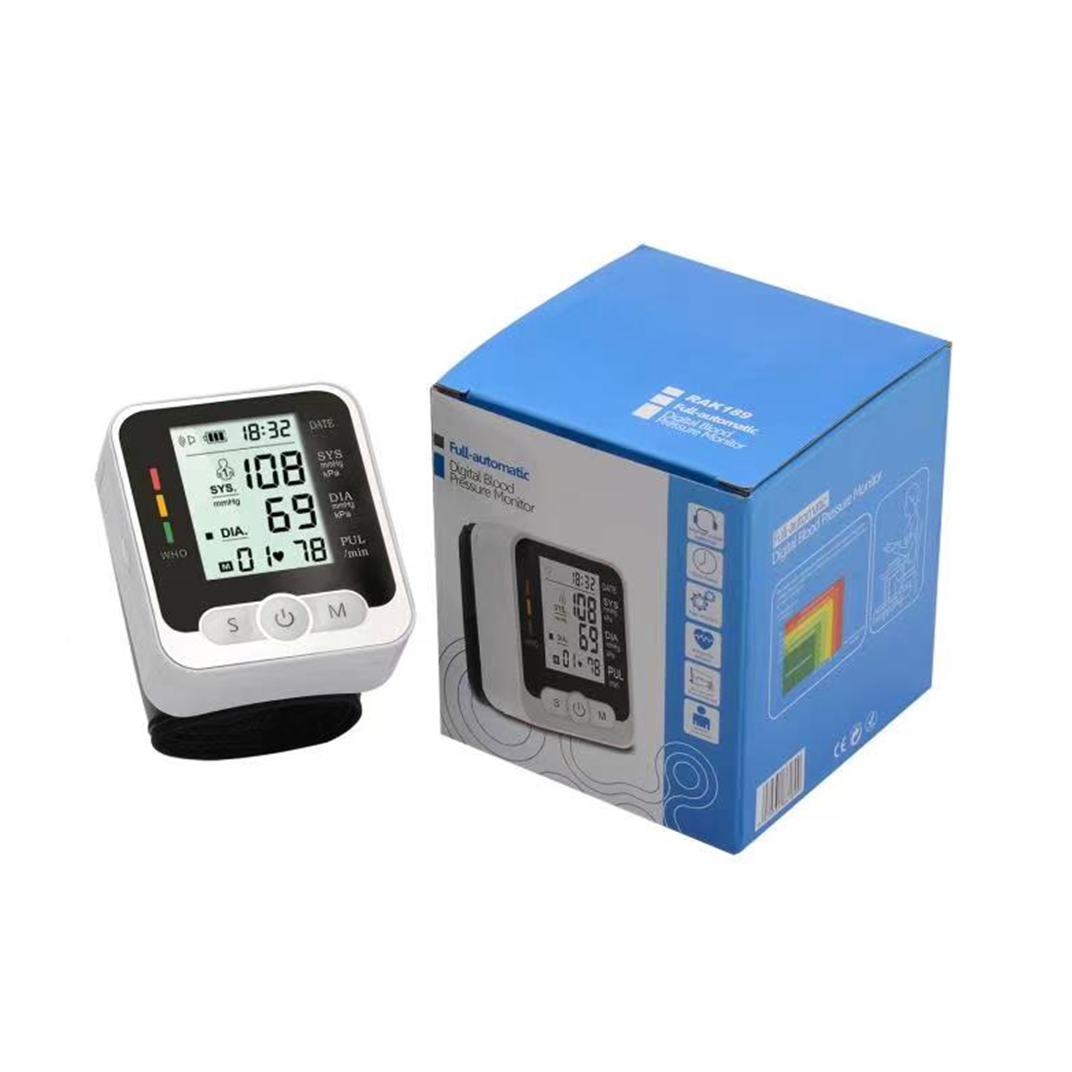
For the three scenarios above, the category to look at is the automated oscillometric monitor. UNIMED’s wrist blood pressure monitor RAK189 is a compact example of the format: the user wraps it on the wrist, presses one button, and the device inflates, measures and displays systolic pressure, diastolic pressure and pulse rate without any stethoscope or manual valve operation.
To be explicit about what this device is and is not: the RAK189 is not a mechanical blood pressure monitor. It uses an electronic pressure sensor and an oscillometric algorithm, and it is covered by the automated device standards rather than ISO 81060-1. It is included here because it solves the specific problem that makes mechanical monitors unsuitable for unsupervised use.
Technical specifications
- Product typeWrist-type electric digital blood pressure monitor
- ModelRAK189
- Measurement methodOscillometric, with intelligent automatic pressurisation and deflation
- DisplayDigital LCD, with kPa / mmHg unit switching
- Measurement rangePressure 20–280 mmHg (0.4–37.3 kPa); pulse 40–199 beats/min
- Declared accuracyPressure ±3 mmHg (0.4 kPa); pulse within ±5%
- Wrist circumference135–195 mm
- MemoryDual-user memory, 99 readings per user, with last-three-measurement average
- User guidanceWHO blood pressure classification strip; incorrect-operation prompt
- Power3 V — 2 × AAA alkaline batteries
- Auto power-off1 minute after the last operation
- Dimensions / weight67 × 68 × 31 mm; approx. 115 g
- CertificatesCE, RoHS, FCC
- CustomisationOEM / ODM available — logo, colour box and voice language options
The features that matter for unsupervised use are the dual 99-reading memory with automatic averaging, which lets a clinician review a trend rather than a single number, and the WHO classification strip, which gives the user an immediate reading of where the value sits without interpretation. Auto power-off at one minute keeps battery consumption predictable.
The honest limitation
Wrist monitors are more sensitive to positioning than upper-arm devices. The wrist has to be held at heart level and kept still during the measurement, and the 2019 AHA statement notes that although wrist devices have been validated, they face real difficulty in achieving accurate readings in practice, largely for that reason. The device cannot compensate for a wrist that has drifted below heart level.
So the recommendation depends on the use case rather than on the product. Where wrist monitoring suits a portable, single-user routine, the RAK189 fits. Where a clinician needs the most positioning-tolerant home format, an upper-arm device is the safer default — UNIMED supplies these alongside the wrist model, including the RAK288, KD-595, B871 and AJC001. Whichever format you choose, the measurement discipline — rest, seated posture, arm at heart level, cuff on bare skin — still determines the quality of the number.
Mechanical, Wrist or Upper-Arm: Decision Table
| Use case | Recommended format | Why |
|---|---|---|
| Clinic with trained nursing staff, high patient volume | Mechanical (aneroid), wall-mounted or palm-style | Fast one-handed operation, no power dependency, shared across patients |
| Ambulance, field team, mobile clinic, unstable power | Mechanical handheld | No batteries, survives cold and impact, individual spare parts |
| Patient monitoring at home alone | Automated — upper-arm preferred, wrist acceptable | One-button operation; upper-arm is most positioning-tolerant |
| Portable personal use, travel, single user | Automated wrist (e.g. RAK189) | Compact and light, dual memory, no stethoscope needed |
| Community screening with non-specialist staff | Automated oscillometric | Removes operator variability; consistent protocol across staff |
| Home monitoring programme issued by a clinic | Automated with memory and averaging | Reviewable trend data instead of handwritten single readings |
| Checking or cross-verifying another device | Calibrated mechanical or mercury reference | Independent reference not dependent on the algorithm being tested |
| Dialysis / vascular access assessment | Specialist wrist aneroid, by trained staff | Purpose-built for fistula monitoring, not general screening |
Sourcing Checklist for Distributors and OEM Buyers
Blood pressure monitors are frequently ordered in volume for distribution, tender supply or private-label programmes, and the questions that decide whether an order succeeds are rarely about the headline specification. The following checklist covers what to confirm with a wholesale supplier before committing.
Device and documentation
- Intended use and population. Confirm whether the device is labelled for adults only or for a broader population, and whether it is intended for professional or home use.
- Cuff or wrist range. The supplied cuff must cover a realistic share of your target market. The RAK189 wrist cuff covers 135–195 mm; if your market skews to larger limbs, an upper-arm model with a wider cuff range will reduce returns.
- Standard cited. Ask specifically which standard the device is tested against — ISO 81060-1 for aneroid, IEC 80601-2-30 with ISO 81060-2 validation for automated. A generic “CE certificate” answer is not sufficient.
- Test reports. Request the pressure-accuracy test data, not just a certificate of conformity.
- Manufacturer quality system. ISO 13485 registration for the production facility, plus the labelling and instructions for use in the languages you need.
- Warranty and calibration policy. Especially relevant for aneroid devices, where the calibration interval drives lifetime cost.
Commercial terms
- OEM / ODM scope. Confirm what is customisable — logo printing, colour box artwork, retail packaging, voice language, manual translation — and what the tooling or minimum quantity threshold is for each.
- Sample and validation before mass production. Order a production sample, verify it against your own reference device, and only then release the bulk order.
- Spare parts availability. Cuffs, bladders, bulbs and tubing should be orderable separately if you are selling mechanical devices into a market where servicing matters.
- Registration support. Ask what documentation the supplier provides for your local device registration or customs clearance.
UNIMED Medical supplies blood pressure monitors and general medical consumables to distributors across Africa and other markets, with electronic blood pressure monitors available for wholesale and OEM programmes. For volume pricing, sample requests or a specific specification question, contact the team with your target market and order volumes.
Frequently Asked Questions
What is a mechanical blood pressure monitor?
A mechanical blood pressure monitor, also called an aneroid sphygmomanometer, is a non-automated device that measures blood pressure using a hand-inflated cuff, a mechanical dial gauge and a stethoscope. The operator inflates the cuff manually, releases the pressure at a controlled rate, and identifies systolic and diastolic pressure from the Korotkoff sounds heard through the stethoscope. It requires no electricity and has no electronic components.
Are mechanical blood pressure monitors more accurate than digital ones?
A well-calibrated aneroid device is accurate within ±3 mmHg, as specified by ISO 81060-1, and the auscultatory method it uses remains a recognised clinical reference. A validated automated device is also accurate, but through a different route: an oscillometric algorithm proven in a clinical validation study under ISO 81060-2. Neither category is inherently more accurate. In practice, mechanical readings depend on operator technique and current calibration, while digital readings depend on correct cuff placement and validation status. An out-of-calibration aneroid is far less accurate than a validated digital monitor, and a badly positioned digital monitor is no better than a careless manual reading.
Can I use a mechanical blood pressure monitor on my own?
Both are non-automated and both are read by an operator, but the pressure-sensing element differs. A mercury sphygmomanometer indicates pressure by the height of a mercury column, which is highly precise and does not need recalibration, but it contains a hazardous substance and is subject to international phase-out. An aneroid sphygmomanometer uses a mechanical capsule and a dial, contains no mercury and is easier to transport, but needs periodic recalibration because mechanical shock can shift the needle.
Is a wrist or an upper-arm blood pressure monitor better?
Upper-arm devices are generally preferred for home monitoring because the brachial artery is at a consistent depth and closer to heart level, making readings less sensitive to positioning. Wrist monitors are more compact and easier to carry, but they require the wrist to be held exactly at heart level and kept still, and the 2019 AHA statement notes that wrist devices — while validated — face real difficulty in achieving accurate measurement in practice. A wrist monitor is a reasonable choice for portable single-user use; an upper-arm monitor is the more positioning-tolerant option.
Is the RAK189 a mechanical blood pressure monitor?
No. The UNIMED RAK189 is an electronic oscillometric wrist blood pressure monitor. It has no inflation bulb, no dial gauge and no stethoscope; it inflates automatically, detects pressure oscillations with an electronic sensor, and displays systolic pressure, diastolic pressure and pulse on an LCD. It is governed by the automated device standards rather than ISO 81060-1. It is the appropriate choice for the situations where a mechanical monitor does not work — unsupervised self-measurement, portable personal use and screening by non-specialist staff.
What should a distributor check before buying blood pressure monitors in bulk?
Confirm five things: the standard the device is tested against (ISO 81060-1 for aneroid, IEC 80601-2-30 with ISO 81060-2 validation for automated); the actual pressure-accuracy test report rather than only a certificate; the cuff or wrist circumference range against your target market; the packaging and carton loading data, since it drives landed cost; and the OEM or ODM scope, including logo, colour box and instruction manual customisation. For aneroid devices, also clarify the calibration and warranty policy, because recalibration dominates lifetime cost.
Sources and further reading
- International Organization for Standardization. ISO 81060-1:2007 — Non-invasive sphygmomanometers, Part 1: Requirements and test methods for non-automated measurement type. iso.org/standard/42914.html
- Muntner P, Shimbo D, Carey RM, et al. Measurement of Blood Pressure in Humans: A Scientific Statement From the American Heart Association. Hypertension. 2019;73(5):e35–e66.
- World Health Organization. WHO calls for the phase out of mercury fever thermometers and blood pressure measuring devices by 2020. 11 October 2013. who.int
- UNEP. Minamata Convention on Mercury, Article 4 — Mercury-added products.
- World Health Organization / Health Care Without Harm. Developing national strategies for phasing out mercury-containing thermometers and sphygmomanometers in health care. WHO, 2013.
- European Commission Scientific Committee on Emerging and Newly Identified Health Risks (SCENIHR). Mercury Sphygmomanometers in Healthcare and the Feasibility of Alternatives. 2009.
- UNIMED Medical. Blood Pressure Monitor: How It Works and How to Use It. unimedmedical.net/blood-pressure-monitor-guide/