Choosing a wound care products manufacturer involves more than comparing product prices. Hospitals, medical distributors, importers, and wholesalers need to verify who actually manufactures the products, whether the specifications match their requirements, what quality and regulatory documents are available, and how consistently the supplier can support repeat orders. A suitable partner should be able to demonstrate product suitability and provide verifiable documentation for the intended market.
For B2B buyers, the most effective starting point is to define the required wound care products, identify the destination market, and establish clear acceptance criteria before requesting quotations. This makes supplier comparisons more meaningful and reduces the risk of purchasing products that do not meet the buyer’s technical or regulatory requirements.
What Products Does a Wound Care Products Manufacturer Supply?
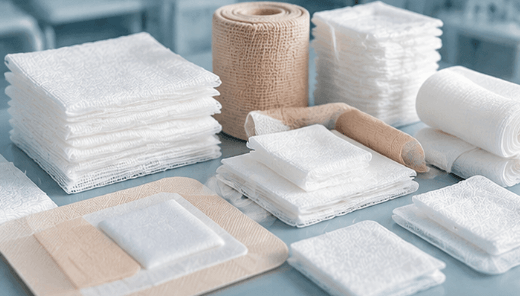
Wound care products cover several product groups used for wound protection, dressing fixation, and the management of wound fluid. The exact portfolio varies by manufacturer, and buyers should confirm individual products rather than assume that every supplier offers the full range.
Common categories include:
- Gauze swabs and gauze dressings: Products made from woven or other specified materials for applications described in their labeling.
- Absorbent wound pads: Products designed to absorb fluid according to their documented specifications.
- Adhesive dressings: Dressings that incorporate an adhesive component or fixation structure.
- Bandages and fixation products: Products used to secure dressings or provide support, depending on their intended use.
- Specialized wound dressings: Products with specific constructions or material properties intended for defined wound management applications.
These categories are not interchangeable. Dimensions, material composition, construction, sterile status, packaging, and intended use can vary considerably even between products with similar names.
For example, two suppliers may both quote sterile gauze swabs, but their offers may differ in ply, dimensions, packaging quantity, and supporting documentation. Procurement teams should compare the complete specification instead of relying on the product name alone.
Buyers looking for related medical consumables can begin with the UNIMED MEDICAL product catalogue. The catalogue is a starting point for product identification, not a substitute for confirming the availability and specifications of a particular wound care item.
Manufacturer vs. Supplier: Which Business Model Fits Your Needs?
A company described as a wound care products manufacturer may manufacture products directly, work with contract manufacturers, or supply products produced by external factories. Understanding this distinction helps buyers determine which company is responsible for manufacturing, quality documentation, labeling, and product changes.
| Business Model | Typical Role | What Buyers Should Verify |
|---|---|---|
| Direct manufacturer | Produces products or performs defined manufacturing operations | Actual production scope, quality controls, product specifications, and traceability |
| Contract manufacturing arrangement | Uses an external production partner under an agreed arrangement | Responsibilities for production, quality oversight, documentation, and change control |
| Medical product distributor | Resells products manufactured by another company | Product origin, supply authorization where relevant, and access to supporting documentation |
| Trading or sourcing company | Coordinates purchasing across one or more manufacturers | Actual manufacturer identity, supplier qualification procedures, and consistency of documentation |
None of these models automatically guarantees better quality. The appropriate choice depends on the product, the buyer’s documentation requirements, order volume, and supply-chain needs.
A hospital purchasing a limited range of standardized consumables may value consolidated ordering and documentation support. A distributor importing products under its own approved specifications may require closer control over product configuration, labeling, and the identity of the actual manufacturer.
Before approving a supplier, ask:
- Which legal entity manufactures the product?
- Where does the relevant manufacturing take place?
- Who is responsible for product release and quality documentation?
- Does a third party perform sterilization or another critical process?
- Who must be contacted if a batch fails inspection or a product complaint arises?
The answers should be consistent with the quotation, product labeling, contract, and supporting documents.
How to Evaluate a Wound Care Products Manufacturer
1. Check Whether the Product Matches Your Specification
A supplier’s catalogue description is rarely detailed enough to serve as a complete purchasing specification.
For each product, record the characteristics that matter to its intended use and purchasing requirements. These may include:
- Material composition and construction.
- Product dimensions and configuration.
- Absorbency, adhesion, or other relevant performance requirements.
- Sterile or non-sterile status.
- Individual packaging and case quantities.
- Labeling, instructions, and storage requirements.
- Applicable product documentation and acceptance criteria.
Not every characteristic applies to every product. The specification should reflect the actual item and its intended use rather than copy a generic checklist.
If a supplier proposes a substitute, request a comparison against the original requirements. A product that looks similar may have different dimensions, packaging, material composition, or declared use.
2. Review Quality Management and Production Controls
Ask how the supplier controls incoming materials, manufacturing or assembly, packaging, labeling, finished-product inspection, and the release of goods.
The required level of evidence depends on the product and applicable market requirements. Depending on the purchasing arrangement, relevant records may include product specifications, inspection results, test reports, batch information, and procedures for managing nonconforming products.
ISO 13485:2016 is an international standard addressing quality management systems for medical devices and related regulatory purposes. It can be relevant when assessing a qualified organization, but buyers should verify the actual scope and validity of any claimed certification rather than assume every supplier or product is covered. See the official ISO 13485:2016 information.
A useful question is whether the supplier has a documented process for controlling changes to materials, product configuration, packaging, and other approved specifications.
For repeat purchasing, this is particularly important. An order delivered several months after the initial shipment should still match the approved configuration, unless a change has been formally reviewed and accepted.
3. Verify Sterility and Packaging Claims
Not every wound care product is supplied sterile. The required status depends on the product’s intended use, labeling, and applicable requirements.
For a product labeled sterile, buyers should request appropriate supporting documentation and verify the declared sterile status against the product labeling. Where applicable, review information about the sterilization process, sterile barrier packaging, package integrity, and relevant shelf-life or storage conditions.
If sterilization is performed by an external service provider, clarify how the supplier manages responsibilities and retains the relevant records.
Do not accept a general statement such as “medical grade” or “high quality” as proof of sterility. Product-specific evidence is more useful for purchasing approval and subsequent quality investigations.
4. Confirm Regulatory and Labeling Requirements
Regulatory requirements vary according to the destination market, product classification, intended use, and applicable local rules. A document accepted in one country may not meet another country’s requirements.
Before placing an order, identify the documentation required by the importer, regulator, healthcare facility, or distribution channel. Depending on the product and market, this may include:
- Product specifications and technical documentation.
- Product labeling and instructions for use.
- Applicable registration, listing, or conformity documents.
- Relevant quality system certificates.
- Product-specific test reports.
- Sterilization documentation where applicable.
- Manufacturer identification and traceability information.
For products intended for the United States, the FDA provides information on general medical device labeling requirements. These requirements are specific to the US regulatory framework and should not be treated as universal rules for every export destination.
A supplier’s registration or certificate should not automatically be interpreted as approval of every item in its catalogue. Confirm the document holder, product scope, validity, and applicability before relying on it.
5. Assess Traceability and Complaint Handling
Product traceability is an important consideration for distributors, importers, and healthcare organizations that need to investigate product complaints or identify affected shipments.
Ask how the supplier identifies products and batches, what information appears on packaging, and how quality complaints and nonconforming products are investigated.
For products with declared expiry dates, confirm that the relevant information is legible and consistent across packaging and documentation. Storage and handling should follow the product’s labeling and instructions.
Before entering a long-term supply agreement, also establish how the supplier communicates product changes, investigates defects, and responds to requests for supporting documentation. These procedures help buyers maintain consistent purchasing records and manage potential supply-chain problems.
How to Compare Wound Care Product Suppliers
Comparisons are meaningful only when all suppliers quote against equivalent specifications. Otherwise, a lower unit price may reflect a different product configuration or a different level of documentation.
| Evaluation Factor | Questions to Ask | Evidence to Review |
|---|---|---|
| Product suitability | Does the product meet the approved specification? | Product specification and labeling |
| Quality controls | How are materials and finished products inspected? | Relevant quality documents and test results |
| Regulatory readiness | Can the product meet the destination market’s requirements? | Applicable product and conformity documents |
| Sterility and packaging | Are the declared status and packaging requirements supported? | Labeling and relevant supporting records |
| Traceability | Can the supplied product or batch be identified? | Batch information and traceability procedures |
| Commercial terms | What are the MOQ, pack quantities, and payment terms? | Written quotation |
| Supply continuity | How are repeat orders and product changes managed? | Written supply arrangements and change-control procedures |
| Logistics | What are the shipping terms and carton specifications? | Packing details and shipping quotation |
Buyers can use a weighted evaluation scorecard after identifying mandatory requirements. Product suitability and applicable regulatory documentation should be treated as approval conditions, not simply as optional advantages that can be offset by a lower price.
For commercial comparison, calculate the total landed cost where relevant. The final cost may include the product price, packaging, freight, insurance, import duties, inspection expenses, and other applicable charges. The calculation should use equivalent quantities and delivery terms.

What Should a Bulk Purchase RFQ Include?
A clear request for quotation (RFQ) helps manufacturers and suppliers provide comparable offers and identify missing information before an order is approved.
- Product identification: Exact product names, descriptions, and intended uses.
- Technical specifications: Materials, dimensions, construction, and required performance characteristics.
- Sterility requirements: Required sterile or non-sterile status and applicable evidence.
- Destination market: Country of import or sale and known documentation requirements.
- Packaging and labeling: Units per pack, packs per carton, label language, and any applicable private-label requirements.
- Order quantities: Initial quantity, expected repeat-order frequency, and any demand forecast.
- Quality requirements: Required test reports, traceability details, and acceptance criteria.
- Supplier information: Legal company name and identification of the actual manufacturer where relevant.
- Commercial terms: MOQ, unit price, payment terms, lead time, shipping terms, and quotation validity.
- Exceptions: Any unavailable documents, proposed substitutions, or requirements the supplier cannot meet.
Ask each supplier to identify exceptions explicitly. If a requirement cannot be met, the quotation should state the limitation rather than silently replace the specified product with an alternative.
For a broader sourcing review, buyers can also consult UNIMED MEDICAL’s medical disposable consumables guide. It provides related context on disposable medical supplies and purchasing considerations; product-specific requirements should still be assessed separately.
Common Mistakes When Selecting a Wound Care Products Manufacturer
Choosing on Unit Price Alone
A lower price does not necessarily mean better value. Differences in packaging, specifications, documentation, and delivery terms can make quotations difficult to compare. Establish equivalence before making a decision.
Assuming Every Listed Product Is Manufactured In-House
A supplier may coordinate products from several manufacturing partners. This arrangement is not automatically unsuitable, but buyers should know which entity manufactures each product and who is accountable for documentation and quality issues.
Treating Certificates as Proof of Product Suitability
A quality system certificate, product registration, or conformity document has a defined scope. Verify that the document applies to the relevant entity, product, and market before relying on it.
Overlooking Packaging and Labeling
Packaging quantities, label languages, batch information, and storage instructions can affect receiving inspections, warehouse management, and downstream distribution. Confirm these details before production or shipment.
Failing to Document Product Changes
A substitute material, revised packaging configuration, or different manufacturer can affect whether a product still meets the approved specification. Agree on how relevant changes must be communicated and reviewed.
Frequently Asked Questions
How can I verify whether a wound care products company is a manufacturer?
Request the company’s legal details, manufacturing scope, and information identifying the entity responsible for producing the item. If production is outsourced, clarify the relationship between the supplier and the actual manufacturer and verify that the documentation is consistent.
What certifications should a wound care products manufacturer have?
There is no single certificate that automatically establishes suitability for every product and market. Identify the applicable requirements, then verify relevant quality system certificates and product-specific regulatory documentation.
Are all wound care products required to be sterile?
No. Sterility requirements depend on the product, intended use, labeling, and applicable regulations. Confirm the declared status and supporting evidence for each item.
What information should I provide when requesting a bulk quotation?
Provide the exact product specification, quantity, packaging requirements, destination market, required documents, labeling needs, and expected delivery arrangements. Clearly identify mandatory requirements and ask the supplier to disclose any exceptions.
How should I compare two wound care product quotations?
First confirm that both offers meet the same mandatory product and documentation requirements. Then compare packaging, quality controls, minimum order quantities, total landed cost, traceability, and arrangements for repeat orders.
Conclusion
Selecting a wound care products manufacturer is a qualification process rather than a simple price comparison. Buyers should establish the product specification, verify the supplier’s actual role, review the required quality and regulatory evidence, and document commercial and traceability requirements before approving an order.
For hospitals, distributors, and importers, a consistent supplier evaluation process makes quotations easier to compare and provides a clearer basis for managing repeat purchases. When discussing a sourcing requirement with UNIMED MEDICAL, prepare the product list, destination market, estimated quantity, and required documentation so that product availability and suitability can be confirmed against the actual purchasing needs.