
Choosing a reliable surgical dressing supplier requires evaluating material specifications, absorbency, intended use, sterility, packaging, quality documentation, and delivery reliability. For hospitals, medical distributors, and importers, the right supplier should be able to provide consistent products, traceable batches, clear technical specifications, and documentation appropriate to the destination market.
Surgical dressings include gauze dressings, absorbent pads, adhesive dressings, and other wound-care products. These products are not interchangeable: their material construction, fluid-handling properties, and intended applications differ. Buyers should establish clear specifications before requesting quotations and compare suppliers on equivalent requirements rather than unit price alone.
What Should a Surgical Dressing Supplier Provide?
A surgical dressing supplier may offer different types of wound-care products for hospitals, clinics, healthcare distributors, and medical supply wholesalers. The available range depends on the supplier’s catalogue and sourcing arrangements.
For B2B buyers, four factors deserve particular attention:
- Product suitability: Materials, dimensions, construction, and performance meet the purchase specification.
- Quality assurance: The supplier can provide relevant product specifications, test documentation, and traceability information.
- Regulatory documentation: Product labeling and conformity documents meet applicable destination-market requirements.
- Supply reliability: Minimum order quantities, lead times, packaging arrangements, and repeat-order capacity are clearly communicated.
Buyers should also establish whether the supplier manufactures products directly or sources them from other manufacturers. A trading company may provide access to several product categories, while a manufacturer may offer more direct visibility into specific production processes. Neither model guarantees quality; documented controls and verifiable product information matter more than the business label.
For buyers sourcing several types of healthcare consumables, the medical consumables category provides an entry point to UNIMED Medical’s existing product catalogue.
Common Surgical Dressing Materials and Types
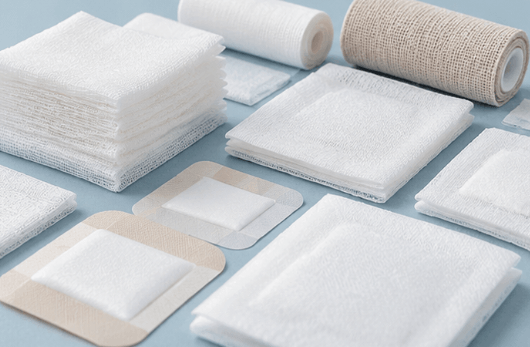
The material used in a surgical dressing affects its structure, conformability, absorbency, and suitability for a particular application. Procurement teams should compare technical specifications rather than relying on broad descriptions such as “medical gauze” or “wound pad.”
| Type | Typical characteristics | What buyers should verify |
|---|---|---|
| Cotton gauze | Woven fibre construction | Material composition, dimensions, ply, and linting characteristics |
| Nonwoven dressing | Fibres bonded or entangled without conventional weaving | Composition, strength, softness, and intended use |
| Absorbent wound pad | Designed to absorb fluid according to its specification | Absorbency data, dimensions, fluid retention, and backing |
| Adhesive dressing | Includes an adhesive component for fixation | Adhesive properties, skin-contact materials, and removal characteristics |
| Composite dressing | Combines layers with different functions | Layer construction, fluid handling, and supported product claims |
| Conforming bandage | Used to secure dressings or provide support, depending on design | Width, length, elasticity, and intended application |
These categories describe general product designs. Actual performance depends on the specific construction and manufacturer.
Cotton gauze versus nonwoven dressing
Cotton gauze commonly uses a woven structure, while nonwoven dressings use fibres bonded or mechanically entangled into a sheet. Both can serve different wound-care purposes, but neither material name alone establishes product quality.
When comparing quotations, request the fibre composition, dimensions, ply or layer information where relevant, and any required performance test results. If low linting, a particular absorbency level, or another characteristic is important, specify the requirement explicitly.
Adhesive and composite dressings
Adhesive dressings combine a dressing layer with an adhesive system or fixation structure. Composite dressings contain multiple layers designed to provide different functions.
For these products, confirm:
- The intended application and compatible use conditions.
- The material of the wound-contact layer.
- Adhesive properties and relevant skin-contact information.
- Sterile or non-sterile status.
- Any restrictions or performance claims stated in the product labeling.
Do not assume that antimicrobial activity, extended wear, or advanced moisture management is a standard feature. Such claims require product-specific supporting evidence.
How to Evaluate Surgical Dressing Quality
A reliable supplier should be able to explain the specifications of the products being offered and provide documentation appropriate to their intended use. A product photograph or short catalogue description is not enough for technical approval.
Material consistency and absorbency
Material consistency is important when hospitals and distributors purchase the same dressing repeatedly. Changes in dimensions, construction, absorbency, or packaging can affect inventory standards and product acceptance.
If absorbency is a key purchasing requirement, request relevant test methods and results. Compare products using equivalent test conditions, because a higher numerical result from one method may not be directly comparable with a result obtained using another method.
For repeat orders, retain the approved product specification and establish acceptance criteria before shipment.
Sterility and packaging integrity
Not all surgical dressings are supplied sterile. Buyers should confirm the product’s declared status rather than assume that every dressing requires the same sterilization process.
For products labeled sterile, verify:
- The declared sterile status and applicable sterilization method.
- Supporting sterilization documentation when required.
- The integrity and suitability of the sterile barrier packaging.
- Batch identification and expiry information, where applicable.
- Storage and handling instructions.
The FDA’s medical-device sterilization guidance provides information on sterilization considerations. Buyers must still confirm which requirements apply to their particular product and destination market.
Skin-contact materials and biological safety
For dressings that contact the body, material safety should be evaluated according to the product’s intended use, contact type, and duration.
ISO 10993-1 describes a framework for biological evaluation of medical devices within a risk-management process. It does not mean that every dressing requires the same set of tests. The appropriate evaluation depends on the product and applicable regulatory requirements.
Quality documentation and traceability
Before approving a supplier, request the documents relevant to the specific product and market. These may include:
- Technical data sheets and product specifications.
- Label and packaging samples.
- Applicable conformity or registration documentation.
- Test reports supporting required performance claims.
- Batch identification and traceability information.
- Sterilization validation information where relevant.
- Quality-management-system certificates, where claimed and applicable.
If a supplier claims ISO 13485 certification, verify the certificate’s validity, scope, issuing body, and coverage of the relevant organization or activities. A quality-management certificate should not be treated as automatic proof that every product meets every destination-market requirement.
What Should Buyers Include in a Surgical Dressing RFQ?
A request for quotation (RFQ) should define the product clearly enough for suppliers to submit comparable offers. Two quotations for “sterile gauze dressing,” for example, may cover different dimensions, materials, packaging quantities, or documentation requirements.
| RFQ requirement | Details to specify |
|---|---|
| Product identification | Product name, reference number, and intended use |
| Material | Fibre composition and construction |
| Dimensions | Length, width, thickness, ply, or other relevant measurements |
| Performance | Required absorbency, adhesion, strength, or other documented attributes |
| Sterility | Sterile or non-sterile status and applicable evidence |
| Packaging | Individual wrapping, units per inner box, and cartons per shipment |
| Shelf life | Declared shelf life and minimum remaining shelf life at delivery, if required |
| Documentation | Technical specifications, applicable certificates, and test reports |
| Commercial terms | MOQ, unit price, lead time, payment terms, and delivery terms |
| Logistics | Carton dimensions, gross weight, shipping arrangements, and export documents |
Not every field applies to every product. The RFQ should reflect the actual specification and applicable regulatory requirements.
For broader purchasing considerations, UNIMED Medical’s existing article, What Are Medical Consumables? Types, Uses and Examples, discusses medical consumables and supplier evaluation. This provides related context without replacing product-specific technical requirements.
How to Compare Surgical Dressing Suppliers
Supplier evaluation should consider technical suitability, documentation, commercial terms, and delivery performance together.
| Evaluation factor | Questions to ask |
|---|---|
| Product capability | Can the supplier provide the required dressing type, material, and dimensions? |
| Quality control | How are specifications checked, and how are nonconforming products handled? |
| Regulatory documentation | Can the supplier provide documents relevant to the target market? |
| Manufacturing or sourcing model | Is the supplier the manufacturer or a sourcing partner? |
| Packaging flexibility | Are different packaging quantities or private-label options available? |
| Supply continuity | Can the supplier support repeat orders and communicate lead-time changes? |
| Commercial terms | Are MOQ, prices, payment terms, and shipping costs clearly stated? |
| Complaint handling | Who is responsible for investigating defects or documentation discrepancies? |
Manufacturer versus trading supplier
Purchasing directly from a manufacturer may provide more direct access to production information and product customization. A trading supplier or sourcing partner may be more convenient when buyers need products from multiple manufacturers.
The appropriate model depends on order volume, technical requirements, the product range, and the buyer’s capacity to manage multiple suppliers. Regardless of the model, clarify who is responsible for product documentation, quality issues, and delivery commitments.
For distributors purchasing several medical product categories, the existing article One-stop Sourcing vs Multiple Suppliers explores the trade-offs in supplier coordination and purchasing administration.
Why the lowest quotation may not be the best option
Unit price is only one component of total procurement cost. Buyers should also consider product conformity, packaging efficiency, expiry dates, freight cost per usable unit, documentation gaps, and delivery reliability.
For example, a low-priced dressing may not be the most economical option if it uses a different specification from the approved product or requires additional verification before import. Comparing equivalent specifications first makes commercial negotiations more meaningful.

Regulatory and Export Considerations
Requirements for surgical dressings vary by product classification, intended use, claims, and destination market. A basic gauze product and a specialized dressing making additional performance claims may be subject to different regulatory expectations.
Before placing an export order, confirm:
- Product classification: Establish how the product is regulated in the destination market.
- Registration or conformity requirements: Identify which approvals and documents apply to the specific product.
- Labeling requirements: Confirm required languages, intended-use information, warnings, and product identification.
- Sterility documentation: Verify requirements if the product is supplied sterile.
- Import documentation: Confirm requirements with the importer, customs broker, and relevant authorities.
The World Health Organization’s medical-device technical specification resources provide useful procurement context on defining technical requirements before purchase.
Do not assume that CE marking, FDA authorization, or a particular quality-system certificate is universally required for every surgical dressing. Ask the supplier to identify the applicable requirements and provide verifiable documentation for the specific product.
How to Request a Quotation from a Surgical Dressing Supplier
A clear inquiry helps suppliers assess the request and reduces unnecessary clarification.
Include:
- Dressing type and intended application.
- Required material, dimensions, and performance specifications.
- Sterile or non-sterile requirement.
- Packaging format and private-label requirements, if applicable.
- Estimated order quantity and expected repeat-order frequency.
- Destination country and known registration or documentation requirements.
- Target delivery date and preferred shipping terms.
If the specification is incomplete, start with the product type, approximate size, order quantity, and destination market. Ask the supplier to identify the missing information required for a firm quotation.
For larger orders, consider requesting samples, reviewing product documentation, and agreeing on acceptance criteria before committing to shipment. Samples can help with preliminary assessment, but they should not replace required technical documentation or regulatory review.
Buyers wishing to discuss a product range or request commercial information can contact UNIMED Medical. Confirm the availability of the specific dressing, its specifications, documentation, MOQ, and quotation terms directly with the supplier.
Conclusion
Selecting a surgical dressing supplier requires more than comparing unit prices. Buyers should verify material specifications, product performance, sterility and packaging claims, traceability, regulatory documentation, and supply capacity before approving a supplier.
For hospitals, distributors, and medical importers, a standardized RFQ and supplier evaluation process helps reduce specification mismatches and makes quotations easier to compare. The most suitable supplier is one that can demonstrate product suitability, provide verifiable documentation, and meet commercial and delivery requirements consistently.
Frequently Asked Questions
1. What should I look for in a surgical dressing supplier?
Evaluate product specifications, material consistency, absorbency requirements, sterility claims, packaging integrity, traceability, applicable regulatory documentation, delivery reliability, and the supplier’s process for handling quality complaints.
2. What materials are commonly used in surgical dressings?
Common materials include cotton gauze, nonwoven fibres, absorbent pads, and adhesive components. The right choice depends on the intended use, product construction, and verified performance characteristics.
3. Are all surgical dressings supplied sterile?
No. Surgical dressings may be supplied sterile or non-sterile. Buyers should verify the product label, intended use, and supporting documentation before purchase.
4. What documents should I request from a surgical dressing supplier?
Depending on the product and destination market, request technical specifications, labeling, applicable conformity or registration documents, test reports, traceability information, and sterilization evidence where relevant.
5. How can medical distributors compare surgical dressing quotations?
Use the same RFQ specification for every supplier. Compare equivalent materials, dimensions, performance requirements, packaging quantities, documentation, minimum order quantities, lead times, freight costs, and payment terms.